1.0 Introduction
The increasing digitalisation of hybrid environments has transformed how experience is created, perceived, and valued. Across professional, educational, and service contexts, this transformation is most evident in the emergence of phygital experience, where physical and digital modes of participation are interwoven. Practices historically grounded in embodied, relational presence are now extended through digital infrastructures (e.g., online sessions, hybrid collaboration, virtual mentorship), reshaping how participants and facilitators interact, interpret, and sustain value.
Rather than replacing physical interaction, phygital environments reconfigure how relational and experiential value is produced across modalities. Interactions occurring both in person and through digital mediation carry cognitive, emotional, and contextual significance, forming an interconnected ecology of experience. Within this ecology, value is not solely derived from outcomes or transactions but emerges through ongoing interaction, interpretation, and connection.
Customer Experience (CX) research provides a foundation for examining these dynamics. Originating in marketing and service design, CX has evolved to address how individuals engage with organisations across multiple touchpoints that generate cognitive, emotional, and sensorial responses. However, its application to professional and educational phygital contexts remains limited. Existing frameworks are often oriented toward commercial environments and managerial optimisation, with less emphasis on the relational, co-creative, and meaning-making dimensions that characterize hybrid, embodied practices.
The literature review identified several gaps relevant to this study. First, existing models tend to privilege either operational design or experiential meaning, with limited integration between the two. Second, they often underrepresent the contextual and relational forces that shape how value is experienced across physical and digital environments. Third, participant agency and co-creation are insufficiently theorised, particularly in contexts where facilitators, peers, and institutions collectively shape experience over time.
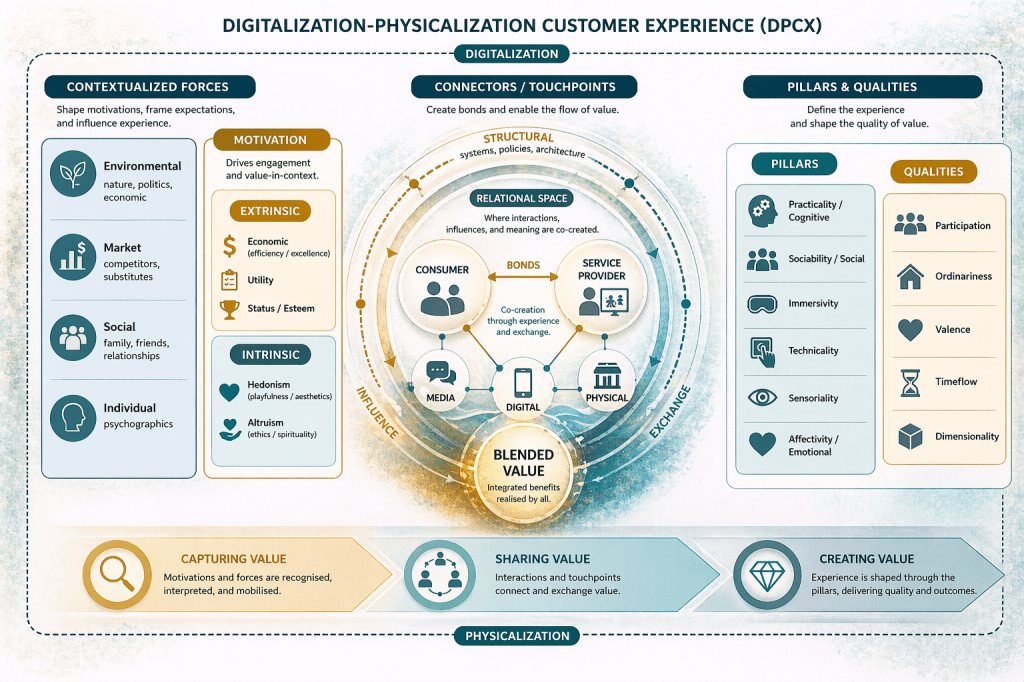
The Digitalisation–Physicalisation Customer Experience (DPCX) framework, previously developed and published (Ahmadi et al., 2026), responds to these limitations by integrating Batat’s Phygital Customer Experience (PH-CX) framework (Batat, 2022) with De Keyser et al.’s (2020) Touchpoints–Context–Qualities (TCQ) model. Through the principle of embedding (Gioia & Pitre, 1990), DPCX links macro-level value structures with micro-level experiential mechanisms, forming a closed-loop system in which operational design and experiential meaning are interdependent.
Within this thesis, DPCX is applied as a sensitizing framework to examine how its components are enacted and experienced within a professional dance education context. The study does not seek to extend the framework conceptually; rather, it explores how touchpoints, context, qualities, connectors, driving forces, and pillars are experienced, negotiated, and interpreted in practice. In doing so, it provides empirical insight into how value is co-created, sustained, and, at times, disrupted across phygital environments.
The purpose of this chapter is twofold. First, it introduces the DPCX framework as the conceptual foundation of the study, situating it within its theoretical and multiparadigm context. Second, it positions the framework as a methodological lens, establishing the rationale for exploring lived experience through an interpretivist approach. The chapter proceeds by outlining the rationale for integration, situating the framework within its theoretical traditions, and describing its core components, before bridging to its empirical application.
1.1 Rationale and Integration
The need for the Digitalisation–Physicalisation Customer Experience (DPCX) framework arises from both conceptual and practical limitations within existing customer experience (CX) research. Despite significant development, the field remains fragmented across disciplinary and paradigmatic lines. Much of the literature emphasises either managerial optimisation of how organisations design and measure experience or interpretive understanding of how participants construct meaning and value. Few frameworks integrate these perspectives or account for how operational design and relational value co-evolve within phygital environments.
Two influential and complementary frameworks anchor this study: the Touchpoints–Context–Qualities (TCQ) model (De Keyser et al., 2020) and the Phygital Customer Experience (PH-CX) framework (Batat, 2022). Each offers a distinct but partial lens on customer experience.
The TCQ model provides a structured, diagnostic approach. It identifies touchpoints as points of interaction, context as the conditions shaping those interactions, and qualities as the cognitive, emotional, and sensorial responses that emerge. Its strength lies in its clarity and managerial applicability, enabling experience to be mapped and evaluated. However, its emphasis on classification and measurement limits its capacity to capture how meaning and value are constructed across broader relational and experiential systems.
In contrast, the PH-CX framework adopts an interpretivist and humanistic orientation. It conceptualises experience as emergent, relational, and co-created within socio-technical ecosystems. Rather than focusing on measurement, it emphasises meaning, value, and purpose as they are negotiated through interaction among participants, organisations, and technologies. While this perspective provides depth in understanding experience, it offers less structural precision for analysing how experiences are operationalised in practice.
DPCX brings these perspectives into dialogue through integration rather than substitution. It retains the analytic clarity of TCQ at the level of touchpoints, context, and qualities, while incorporating the value-oriented orientation of PH-CX through connectors, driving forces, and pillars. In doing so, it links micro-level experiential mechanisms with macro-level value structures within a single, coherent framework.
A key dimension of this integration is temporality. While TCQ captures experience as a sequence of observable interactions, PH-CX conceptualises it as an unfolding process of meaning-making. DPCX aligns these perspectives through a temporal continuum in which experience evolves across synchronous, asynchronous, and recursive engagement. Value is therefore not produced in isolated moments but develops through cycles of interaction, reflection, and return. This temporal framing enables the framework to account for continuity and transformation in phygital experience.
Through this synthesis, DPCX positions experience as a dynamic interplay between the tangible and the interpretive. Operational design shapes lived experience, while lived experience, in turn, informs and reshapes design. The framework therefore supports analysis that is both diagnostic and interpretive, capturing how experience is structured and how it is experienced.
In addition to integrating its parent frameworks, DPCX introduces three elements that are central to phygital experience. First, connectors represent the relational bonds that sustain engagement across participants, facilitators, and communities. Second, driving forces encompass both contextual conditions and motivational energies, linking external influences with intrinsic and extrinsic motivations for engagement. Third, pillars articulate the aspirational values that align individual, organisational, and societal goals. Together, these elements extend the analytic vocabulary of CX to include relational, motivational, and value-oriented dimensions that are essential in hybrid environments.
The six components of touchpoints, context, qualities, connectors, driving forces, and pillars therefore form an integrated system through which experience can be examined as both structured and emergent. By embedding the operational logic of TCQ within the broader ecosystem orientation of PH-CX, DPCX provides a coherent framework for analysing how value is produced, experienced, and sustained across phygital contexts.
1.2 Embedding TCQ and PH-CX: A Multiparadigm Foundation
1.2.1 Theoretical Orientation
The integration of the TCQ and PH-CX frameworks within DPCX is grounded in a multiparadigm perspective that recognises the coexistence of distinct ontological and epistemological assumptions. Drawing on Gioia and Pitre (1990), this study adopts the position that complex organisational and experiential phenomena cannot be fully understood through a single paradigm. Instead, insight is strengthened through structured dialogue across paradigms.
Gioia and Pitre identify three strategies for engaging multiple paradigms: bridging, linking, and embedding. The DPCX framework employs embedding, whereby one paradigm is nested within another to enable simultaneous examination of complementary dimensions of experience. This approach allows the measurable and the interpretive to be considered together without collapsing their underlying assumptions.
Within the context of customer experience, this perspective is particularly relevant. Operational structures and lived meanings coexist in practice, requiring a framework capable of addressing both how experience is designed and how it is interpreted. The multiparadigm orientation of DPCX therefore provides the conceptual basis for integrating these dimensions within a unified analytical lens.
1.2.2 Embedding Paradigms within DPCX
Within DPCX, the TCQ framework represents the micro-level, operational perspective. It reflects a positivist orientation in which experience is understood as observable and analysable through touchpoints, context, and qualities. This perspective enables the systematic examination of how interactions are structured and delivered.
The PH-CX framework represents the macro-level, interpretive perspective. It adopts a relational ontology in which experience is emergent and co-created within socio-technical systems. Here, value is understood as constructed through interaction, meaning-making, and connection.
DPCX positions these perspectives as complementary rather than oppositional. Through embedding, macro-level value orientations inform micro-level design, while micro-level experiences provide feedback that shapes macro-level understanding. This recursive relationship forms a closed-loop system in which structure and meaning are continuously interdependent.
1.2.3 Dynamic Embedding and Temporality
Embedding within DPCX is not static but dynamic. Experience unfolds through iterative cycles of interaction, interpretation, and adjustment, linking operational processes with evolving meaning.
This dynamic is closely tied to temporality. At the micro level, experience is encountered as a sequence of interactions across touchpoints. At the macro level, it develops as an ongoing process of meaning-making. DPCX integrates these temporal perspectives by conceptualising experience as both sequential and recursive, enabling analysis of how immediate interactions contribute to longer-term value formation.
This temporal integration allows the framework to capture both the flow of experience and its accumulation over time, providing a basis for examining continuity, adaptation, and transformation within phygital environments.
1.2.4 Epistemological Position of the Study
While DPCX is multiparadigmatic in design, its empirical application in this study is grounded in an interpretivist–constructivist stance. Within this orientation, experience is understood as socially constructed and contextually situated, requiring analysis that remains responsive to participants’ perspectives.
Accordingly, the components of the DPCX framework are employed as sensitizing concepts (Blumer, 1954). They guide attention to key dimensions of experience without prescribing fixed categories for analysis. This approach supports inductive inquiry, allowing themes to emerge from the data while remaining theoretically informed.
This positioning aligns with the principles of reflexive thematic analysis (Braun & Clarke, 2006), in which coding is driven by engagement with the data rather than predetermined structures. DPCX therefore functions as an interpretive lens that orients analysis without constraining it, ensuring both theoretical coherence and methodological flexibility.
1.2.5 Application to Professional Dance Education
The embedded, multiparadigm structure of DPCX aligns with the relational and embodied nature of professional dance education. At the micro level, interactions between students and instructors constitute touchpoints that generate immediate cognitive, emotional, and sensorial responses. These interactions are situated within broader institutional, cultural, and technological contexts that shape their meaning.
The relationship between these levels is recursive. Individual experiences inform collective understanding, while institutional values and practices shape individual engagement. This interplay reflects the co-creative nature of experience within phygital environments, where meaning emerges through ongoing interaction across physical and digital domains.
DPCX therefore provides an appropriate framework for examining how experience is structured, interpreted, and sustained within this context.
1.2.6 Summary
In summary, the DPCX framework employs the principle of embedding (Gioia & Pitre, 1990) to integrate the operational clarity of TCQ with the interpretive depth of PH-CX. This multiparadigm foundation enables the framework to address both the measurable and the meaningful dimensions of experience.
By maintaining the integrity of each paradigm while linking them within a unified structure, DPCX provides a coherent basis for analysing how experience is designed, experienced, and transformed within phygital environments.
1.3 Core Components of the DPCX
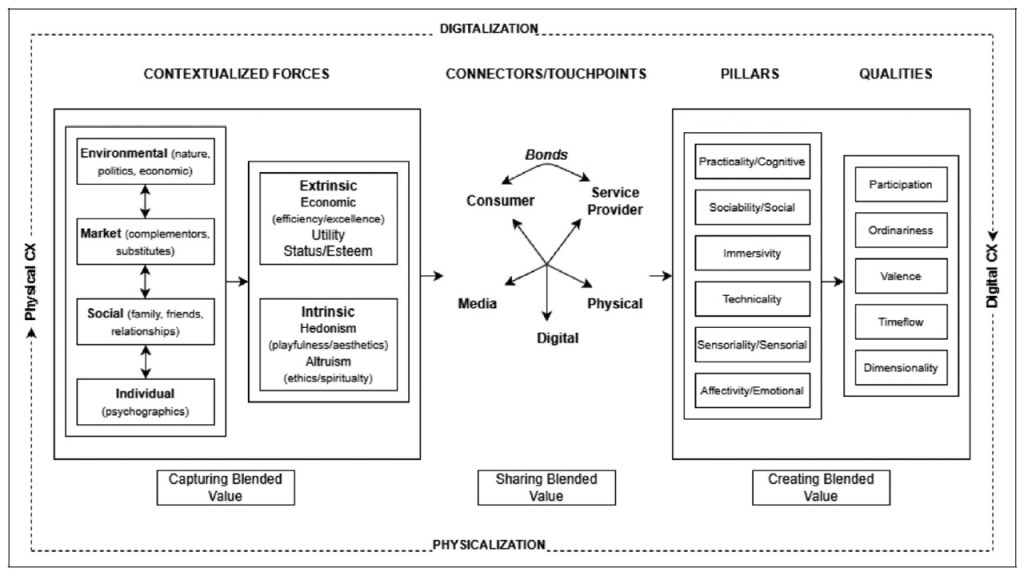
The Digitalisation–Physicalisation Customer Experience (DPCX) framework comprises six interrelated components: touchpoints, context, qualities, connectors, driving forces, and pillars. Together, these elements describe how experience is structured and how value is produced across phygital environments.
The framework integrates the analytic structure of the Touchpoints–Context–Qualities (TCQ) model (De Keyser et al., 2020) with the interpretive orientation of the Phygital Customer Experience (PH-CX) framework (Batat, 2022). Through the principle of embedding (Gioia & Pitre, 1990), these components operate as a closed-loop system linking micro-level interactions with macro-level value formation.
Within this system, the components do not function independently. Touchpoints, context, and qualities capture how experience is enacted at the level of interaction, while connectors, driving forces, and pillars explain how value is sustained, motivated, and aligned over time. The framework therefore enables analysis of both the structure of experience and its interpretation.
1.3.1 Touchpoints: Interfaces of Experience
Touchpoints are the points of interaction through which participants engage with an organisation or system. They include both physical and digital encounters and represent the immediate sites where experience is enacted. Within DPCX, touchpoints are not only operational interfaces but also moments through which meaning is constructed. Each interaction contributes to the overall experience, linking design with perception. In phygital environments, the coherence of experience depends on how effectively physical and digital touchpoints are integrated.
1.3.2 Context: Conditions of Experience
Context defines the conditions under which interactions occur and are interpreted. It is multi-layered, encompassing individual, organisational, and broader socio-technical dimensions. At the micro level, context includes participant characteristics such as expectations, motivations, and readiness to engage. At the meso level, it reflects organisational structures, program design, and cultural norms. At the macro level, it includes wider social, economic, and technological forces. These levels are interdependent. Context is not a passive backdrop but an active structure that shapes how experience is produced and understood.
1.3.3 Driving Forces: Motivational and Contextual Energies
Driving forces represent the energies that initiate and sustain engagement. They include both external influences and internal motivations. Externally, driving forces encompass technological change, social expectations, and broader environmental conditions. Internally, they include intrinsic and extrinsic motivations such as curiosity, achievement, belonging, and recognition. By integrating these dimensions, DPCX positions engagement as shaped by the interaction between individual motivation and contextual conditions.
1.3.4 Pillars: Aspirational Orientation
Pillars represent the values and intentions that guide experience. They articulate the desired orientation of the experience at an individual, organisational, or societal level. Pillars do not describe how experience is felt in the moment but how it is intended to be aligned over time. They provide a reference point against which lived experience can be evaluated, enabling identification of alignment or dissonance between intention and perception.
1.3.5 Qualities: Lived Experience
Qualities capture the cognitive, emotional, sensorial, and behavioural responses that arise during interaction. They represent how experience is perceived and interpreted in the moment. While qualities often share language with pillars (e.g., emotional, relational), they operate at a different level. Qualities reflect lived experience, whereas pillars represent aspirational intent. The relationship between the two provides insight into how effectively experience aligns with its intended values.
1.3.6 Connectors: Relational Continuity
Connectors represent the relationships that sustain experience across time. They include interactions among participants, facilitators, and broader communities, as well as digitally mediated connections. Within DPCX, connectors extend beyond individual interactions to form the relational structure through which experience becomes continuous rather than episodic. They support trust, belonging, and co-creation, enabling value to persist beyond isolated touchpoints.
1.3.7 Operationalizing Embedding: Interlinking Components
The components of DPCX are operationalised through embedded relationships that connect micro-level interactions with macro-level value formation. Driving forces are expressed within context, linking motivation to situational conditions. Connectors are enacted through touchpoints, making relationships visible in interaction. Pillars are realised through qualities, connecting aspirational intent with lived experience. These relationships enable the framework to function as a closed-loop system in which structure and meaning are continuously linked.
1.3.8 Dynamic Interdependence
The six components operate as an interdependent system. Touchpoints generate qualities within a context shaped by driving forces, while connectors sustain relationships and pillars provide orientation. Through ongoing interaction and feedback, the configuration of experience adapts over time. DPCX therefore represents not a static model but a dynamic structure through which experience is produced, interpreted, and sustained across phygital environments.
1.4 Connectivism as the Network Logic of DPCX
1.4.1 The Principle of Connection
The six components of the DPCX framework describe how experience is structured and interpreted across phygital environments. To account for how these components interact and how experience evolves, an additional explanatory perspective is required. Connectivism provides this perspective by offering a relational logic that aligns with the underlying structure of DPCX.
Originating in the work of George Siemens (2004) and further developed by Stephen Downes (2019), connectivism conceptualises learning and meaning as emerging through networks of relationships among individuals, technologies, and systems. Within this perspective, knowledge is distributed across connections rather than located solely within individuals.
Applied to DPCX, connectivism functions as an interpretive lens that explains how value emerges through the interaction of the framework’s components. Touchpoints, connectors, driving forces, and pillars can be understood as nodes within a network, with meaning arising from the relationships among them. Value is therefore produced through alignment across these relationships rather than through isolated interactions.
1.4.2 Temporal and Spatial Flow
The relational logic of connectivism extends across both time and space. In phygital environments, experience unfolds through a combination of synchronous interaction (e.g., live engagement) and asynchronous processes (e.g., reflection, digital feedback). DPCX incorporates this dynamic by recognising that experience is not confined to discrete moments but develops through cycles of interaction, reflection, and return. These cycles allow meaning to accumulate over time, linking immediate encounters with longer-term interpretation.
Spatially, experience is distributed across physical and digital environments. Interaction occurs not only within shared physical spaces but also through mediated platforms that extend connection beyond co-presence. Within this distributed structure, proximity is redefined as relational rather than purely physical, reflecting the extent to which participants experience connection, engagement, and alignment.
1.4.3 Micro-Level Networks: Individual Experience
At the micro level, connectivism explains how individuals construct experience through interaction. Each touchpoint functions as a node within a personal network of engagement, carrying both informational and relational significance. Participants’ experiences of support, challenge, and engagement are shaped by the quality and density of these connections. Strong, consistent connections enable continuity and meaning-making, while fragmented connections may result in disjointed experience and reduced perceived value.
1.4.4 Meso-Level Networks: Organisational Systems
At the meso level, connectivism operates within organisational and programmatic structures. Networks are reflected in communication systems, feedback processes, mentorship relationships, and digital platforms. Facilitators and organisational actors function as both nodes and connectors within these networks, translating institutional values into lived experience. The effectiveness of the environment depends on how well these internal networks support the flow of information, feedback, and relational connection.
1.4.5 Macro-Level Networks: Broader Ecosystems
At the macro level, connectivism situates experience within wider social, cultural, and technological systems. External influences such as industry norms, technological innovation, and societal expectations shape both the conditions of participation and the meanings attached to experience. These broader networks influence how participants engage and how organisations design and deliver experience, reinforcing the interconnected nature of phygital environments.
1.4.6 Network Dynamics and Value Formation
Across these levels, value emerges through the movement of information, interaction, and interpretation within the network. Micro-level interactions contribute to meso-level practices, while macro-level forces shape the broader conditions within which these interactions occur.
Within DPCX, this network dynamic explains how value is not produced at a single point but develops through ongoing interaction and alignment across components. The effectiveness of experience therefore depends on the coherence of these relationships.
1.4.7 Interpretive Alignment
Connectivism reinforces the interpretivist orientation of the study by emphasising that meaning is constructed through interaction. Experience is understood as relational and context-dependent, emerging through engagement rather than existing independently of it. Within this perspective, the DPCX framework can be interpreted as a structured representation of a relational system in which components interact dynamically to produce value. Connectivism does not extend the framework but provides a lens through which its relational dynamics can be understood.
1.4.8 From Network Logic to Empirical Application
By aligning connectivism with DPCX, the study establishes a coherent basis for examining how experience evolves across interconnected systems. This perspective supports an empirical approach that focuses on patterns of interaction, connection, and meaning-making. The following section builds on this foundation by positioning DPCX as a methodological lens, outlining how these relational dynamics are explored through qualitative inquiry.
1.5 Positioning DPCX for Empirical Application
1.5.1 From Conceptual Framework to Methodological Lens
Building on the conceptual and network logic established in the preceding sections, this study positions the DPCX framework as a methodological lens for examining lived experience within phygital environments. While DPCX provides a structured representation of how experience is organised, its role in this research is interpretive rather than prescriptive.
DPCX is not employed as a coding framework or as a set of predefined variables. Instead, it functions as a sensitizing lens that guides attention to key dimensions of experience, including touchpoints, context, qualities, connectors, driving forces, and pillars. This positioning enables the study to remain grounded in participants’ accounts while maintaining theoretical coherence.
1.5.2 Interpretivist Orientation and Sensitizing Concepts
The study adopts an interpretivist–constructivist stance, in which experience is understood as socially constructed and contextually situated. Within this orientation, meaning is not treated as fixed or measurable but as emerging through interaction and interpretation.
In line with this stance, the components of the DPCX framework are employed as sensitizing concepts (Blumer, 1954). Sensitizing concepts provide direction for inquiry without imposing rigid categories, allowing the researcher to engage with the data inductively while remaining theoretically informed.
This approach aligns with reflexive thematic analysis (Braun & Clarke, 2006), where coding is driven by immersion in the data rather than predetermined structures. DPCX therefore informs the analytic focus without constraining the emergence of themes.
1.5.3 Data Collection: Semi-Structured Interviews
Data are generated through semi-structured interviews with participants and facilitators within professional dance education contexts. This method supports exploration of how individuals describe, interpret, and make sense of their experiences across physical and digital environments. The interview approach enables participants to articulate their experiences of interaction, context, motivation, and connection in their own terms. It provides access to how value is perceived and negotiated, as well as how experiences evolve over time.
1.5.4 Temporal and Spatial Dimensions of Inquiry
The research design reflects the temporal and spatial characteristics of phygital experience. Participants describe both synchronous interactions (e.g., live engagement) and asynchronous processes (e.g., reflection, digitally mediated communication), allowing analysis of how experience unfolds across time. Spatially, the study considers both physical and digital environments, recognising that experience is distributed across locations and mediated through technology. This approach captures how presence, proximity, and connection are redefined within phygital contexts.
1.5.5 Analytic Approach: Reflexive Thematic Analysis
Data are analysed using reflexive thematic analysis (Braun & Clarke, 2006), consistent with the interpretivist–constructivist orientation of the study. Analysis proceeds inductively, moving from participants’ accounts toward the development of themes that capture patterns of meaning. The DPCX framework interacts with this process by providing a conceptual lens through which emerging themes are interpreted. Rather than directing coding, the framework supports reflection on how identified patterns relate to the structure and dynamics of experience. Analysis therefore involves a recursive movement between data and theory, allowing insights to be developed in relation to both participants’ accounts and the conceptual structure of DPCX.
1.5.6 Reflexivity and Researcher Positioning
Consistent with an interpretivist approach, the researcher is understood as an active participant in the process of meaning-making. Interpretation is shaped by the researcher’s background, experience, and engagement with the data. Reflexivity is therefore central to the research process. Ongoing reflection ensures that analytic decisions are transparent and grounded, and that the researcher’s influence on interpretation is acknowledged rather than minimised. This positioning aligns with the relational logic of DPCX, where knowledge is understood as emerging through interaction rather than being extracted independently of it.
1.5.7 From Framework to Empirical Inquiry
By positioning DPCX as a sensitizing and interpretive lens, the study maintains alignment between its theoretical foundation and methodological approach. The framework provides a structure for understanding how experience is organised, while the analytic process remains responsive to how it is lived and described by participants. This integration ensures that the empirical findings are both theoretically informed and grounded in the data. The following chapter outlines the research design and procedures through which this approach is implemented.
1.6 Theoretical and Practical Implications
The development and application of the Digitalisation–Physicalisation Customer Experience (DPCX) framework (Ahmadi et al., 2026) carries implications for both customer experience theory and practice. These implications arise not from extending the framework conceptually, but from demonstrating its relevance within a phygital educational context.
1.6.1 Theoretical Implications
At the theoretical level, this study reinforces the value of integrating complementary perspectives within customer experience research. By applying DPCX, the study demonstrates how the operational clarity of the Touchpoints–Context–Qualities (TCQ) model can be examined alongside the interpretive orientation of the Phygital Customer Experience (PH-CX) framework.
This integration supports a view of experience as both structured and interpretive. It shows that experience can be analysed through observable interactions while also being understood as a process of meaning-making shaped by context, relationships, and motivation.
The findings further highlight the importance of relational and motivational dimensions of experience. By examining connectors and driving forces in practice, the study underscores how engagement and value are sustained through interaction, rather than produced at isolated points. Experience is therefore understood as evolving over time through ongoing participation.
In addition, the study reinforces the relevance of temporality in understanding experience. Value is not generated within single interactions but develops across cycles of engagement, reflection, and return. This perspective supports a more dynamic understanding of customer experience in phygital environments.
Finally, by applying DPCX within a professional dance education context, the study contributes to the extension of customer experience research into embodied and educational settings. It demonstrates that frameworks developed in commercial contexts can be meaningfully examined within relational, practice-based environments.
1.6.2 Practical Implications
From a practical perspective, DPCX provides a structured lens for evaluating and designing experience within phygital environments.
For educators and facilitators, the framework highlights the importance of aligning interaction design with relational and motivational dynamics. Touchpoints are not only operational moments but opportunities to support engagement, feedback, and connection. The effectiveness of experience depends on how these interactions contribute to continuity and meaning over time.
For organisations, DPCX emphasises the role of connectors in sustaining engagement. Relationships among participants, facilitators, and communities are central to the experience, extending its impact beyond individual interactions. Supporting these connections can strengthen engagement, belonging, and long-term participation.
The framework also draws attention to the influence of driving forces, including technological change and participant expectations. Organisations must respond to these forces while maintaining alignment with their core values, ensuring that experience remains coherent across physical and digital environments.
Although the study is situated within professional dance education, these insights are applicable across sectors where experience is shaped through a combination of interaction, context, and connection. DPCX therefore offers a practical tool for examining and improving experience in hybrid environments.
1.6.3 Synthesis
Together, these implications demonstrate the value of DPCX as both a conceptual and practical framework. It provides a means of linking operational design with lived experience, enabling analysis of how value is produced and sustained across phygital contexts.
By maintaining alignment between theoretical structure and empirical application, the framework supports both explanation and practice. It offers a coherent approach to understanding how experience is shaped through interaction, interpretation, and connection within hybrid environments.
1.7 Chapter Summary
This chapter has introduced the Digitalisation–Physicalisation Customer Experience (DPCX) framework as the conceptual foundation for examining experience within phygital environments. Building on established customer experience research, the framework integrates the operational structure of the Touchpoints–Context–Qualities (TCQ) model with the interpretive orientation of the Phygital Customer Experience (PH-CX) framework through the principle of embedding (Gioia & Pitre, 1990).
The chapter has outlined the six interrelated components of DPCX (touchpoints, context, qualities, connectors, driving forces, and pillars) and demonstrated how they operate as an integrated system linking micro-level interactions with macro-level value formation. This structure enables analysis of experience as both observable and interpretive, capturing how it is enacted, perceived, and sustained across physical and digital environments.
A multiparadigm foundation was established to support this integration, positioning DPCX as a framework capable of addressing both the measurable and the meaningful dimensions of experience. Connectivism was introduced as an interpretive lens to explain how value emerges through relational dynamics across micro, meso, and macro levels.
The chapter further positioned DPCX for empirical application, defining its role as a sensitizing lens within an interpretivist–constructivist approach. By aligning the framework with reflexive thematic analysis (Braun & Clarke, 2006), the study ensures that analysis remains grounded in participants’ accounts while informed by theoretical structure.
Together, these elements establish a coherent foundation for the empirical investigation that follows. The next chapter outlines the research design, data collection, and analytic procedures through which the DPCX framework is applied to examine lived experience within professional dance education.
References
Ahmadi, S., De Vos, S., Qesja, B., Soleimani, S., Harris, J., Lipnickas, G., Haykal, K.-A., Brochado, A., Rao Hill, S., & Rajic, S. (2026). The Phygital Education Paradigm: Blended Learning and its Impact on Student Experiences in Sport and Dance Education. Journal of Macromarketing, 02761467261424251.
Batat, W. (2022). What does phygital really mean? A conceptual introduction to the phygital customer experience (PH-CX) framework. Journal of Strategic Marketing, 32(8), 1-24.
Blumer, H. (1954). What is Wrong with Social Theory? American Sociological Review, 19(1), 3-10. https://doi.org/10.2307/2088165
Braun, V., & Clarke, V. (2006). Using thematic analysis in psychology. Qualitative research in psychology, 3(2), 77-101. https://doi.org/10.1191/1478088706qp063oa
De Keyser, A., Verleye, K., Lemon, K. N., Keiningham, T. L., & Philipp, K. (2020). Moving the Customer Experience Field Forward: Introducing the Touchpoints, Context, Qualities (TCQ) Nomenclature. Journal of Service Research, 23(4), 433-455. https://doi.org/10.1177/1094670520928390
Downes, S. (2019). Recent work in connectivism. European Journal of Open, Distance and E-Learning (EURODL), 22(2), 113-132.
Gioia, D. A., & Pitre, E. (1990). Multiparadigm Perspectives on Theory Building. The Academy of Management Review, 15(4), 584-602.
Siemens, G. (2004). Elearnspace. Connectivism: A learning theory for the digital age. Elearnspace. org, 14-16.

