WHEN EXPECTATIONS FRACTURE
The Dynamics of Experience in Phygital Professional Education
Understanding Experience in a Phygital World
Students entering professional education do not arrive as blank slates. They carry expectations shaped by identity, peer networks, institutional narratives, and imagined futures.
In phygital environments where physical and digital learning intersect, these expectations are not always met. Instead, they are often disrupted, creating moments of tension, misalignment, and uncertainty.
These moments matter.
They shape how students experience their learning, how they relate to others, and ultimately whether they persist, adapt, or leave.
The Problem: When Expectation Meets Reality
The expansion of digital and hybrid learning has transformed professional education. While these environments offer flexibility and access, they also introduce new forms of inconsistency.
What students expect and what they actually encounter, can diverge.
These gaps are not simply technical or structural. They are:
- embodied (felt in the body and practice)
- relational (experienced through interactions with others)
- emotional (shaping confidence, belonging, and identity)
Understanding these gaps requires looking beyond design and delivery—toward the lived experience of students navigating these environments.
Research Contribution
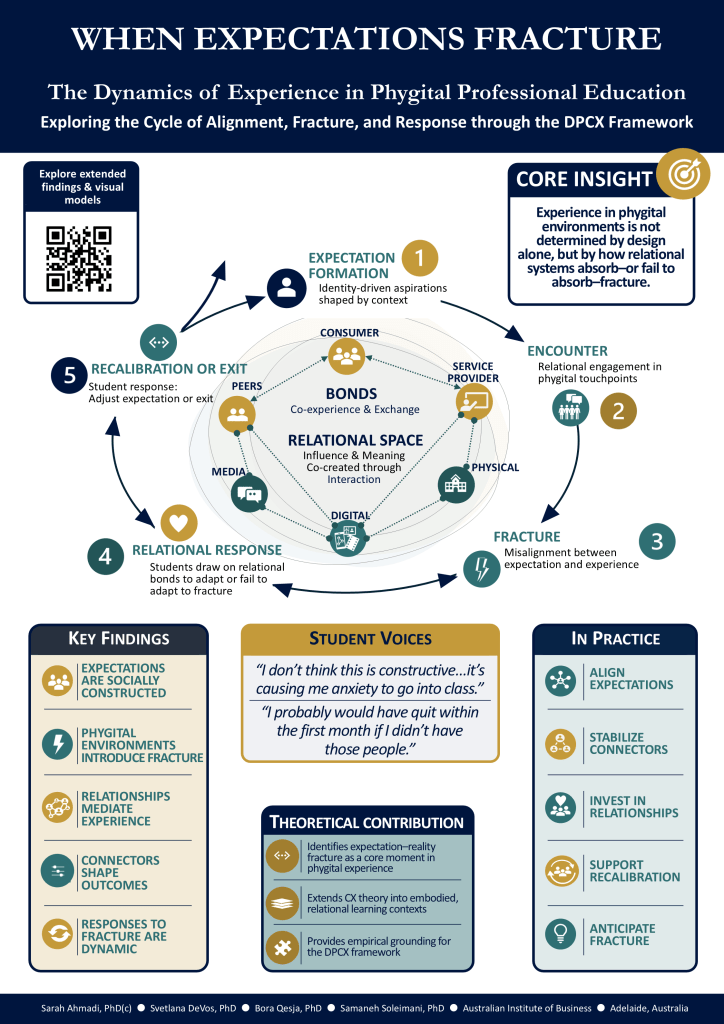
This research extends the Digitalization–Physicalization Customer Experience (DPCX) framework by identifying fracture as a critical moment in the experience cycle.
It shows that:
- Experience is not stable or uniform
- Misalignment between expectation and experience is common
- Outcomes depend on how that misalignment is mediated through relationships
Rather than focusing only on systems or structures, this work foregrounds the relational dynamics that shape whether experiences hold together—or break apart.
The Experience Cycle
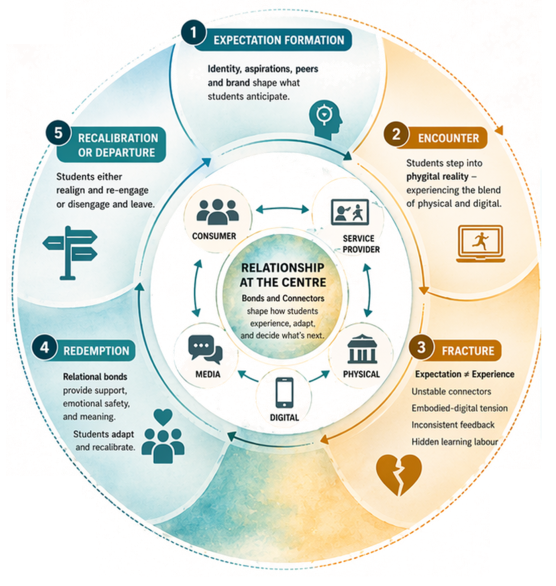
Experience in phygital professional education unfolds through a dynamic cycle:
- Expectation Formation
Identity-driven aspirations shaped by peers, institutions, and context - Encounter
Engagement across physical, digital, and relational touchpoints - Fracture
Misalignment between expectation and lived experience - Relational Response
Peers, teachers, and communities mediate the experience - Recalibration or Exit
Students adapt, persist, or disengage
This cycle is not linear. It is shaped by contextual forces and continuously negotiated through relationships.
Core Insight
Experience in phygital environments is not determined by design alone, but by how relational systems absorb—or fail to absorb—fracture.
Voices from the Study
“I don’t think this is constructive… it’s causing me anxiety to go into class.”
“I probably would have quit within the first month… if I didn’t have those people.”
“The peers were like one of the most important parts to me.”
“The people around me helped me get through it more than anything.”
“The support wasn’t there 100%… it wasn’t really there.”
“My peers were my saving grace.”
“What I didn’t expect is that I wouldn’t learn anything new…”
These experiences highlight both the strain created by misalignment and the critical role of relationships in sustaining engagement.
Implications for Practice
Designing effective phygital learning environments requires more than integrating technology. It requires attention to how experiences are lived and negotiated.
This includes:
- Aligning expectations
Clearly communicating program realities and learning journeys - Stabilizing connectors
Ensuring consistency across feedback, progression, and modalities - Investing in relationships
Building communities that provide belonging and support - Supporting recalibration
Creating space for reflection, adjustment, and identity development - Anticipating fracture
Recognizing where misalignment is likely and designing for it
About the Study
This research draws on qualitative interviews with students and instructors in professional dance education, examining how experience unfolds in phygital training environments.
It contributes to ongoing work in customer experience, experiential learning, and relational dynamics in education.
For more information on the DPCX Conceptual Framework Development, click here to access the paper on its development. To read more about the DPCX Framework and its application in dance and sport, click here to access the Journal of Macromarketing’s published article.
Continue the Conversation
If this work resonates or connects to your research or practice, we would welcome the conversation.
Sarah Ahmadi
PhD Candidate
Australian Institute of Business [LinkedIn: linkedin.com/in/sarah-r-ahmadi]
Svetlana De Vos, PhD
Australian Institute of Business
Bora Qesja, PhD
Australian Institute of Business
Samaneh Soleimani, PhD
Australian Institute of Business